

Deals Of The Day
Click to Close
History of Pearls: As far back as 2300 BC, Chinese records indicate...
VIEW DETAILS QUICK PREVIEW1. History of Pearls
History of Pearls:
As far back as 2300 BC, Chinese records indicate that pearls were the prized possessions and gifts to royalty. In ancient Rome pearls were a highly prized accessory and own as a symbol of wealth and prestige. The ancient Greeks also highly valued pearls, using them especially at weddings where they were said to bring love.
At the height of the Roman Empire, when pearl fever reached its peak, the historian Suetonius wrote that the Roman general Vitellius financed an entire military campaign by selling just one of his mother’s pearl earrings.

Mary, Queen of Scots wearing her rope of famous black pearls.
A reverence for pearls spread throughout the world over the ensuing millennia. India’s sacred books and epic tales abound with pearl references. One legend has the Hindu god Krishna discovering pearls when he plucks the first one from the sea and presents it to his daughter Pandaïa on her wedding day.
In Egypt, decorative mother-of-pearl was used at least as far back as 4200 B.C., but the use of pearls themselves seems to have been later, perhaps related to the Persian conquest in the fifth century B.C.

Queen of Italy, Margherita of Savoy, owned one of the most famous collections of natural pearls. She is wearing a multi-strand choker and a rope of pearls, possibly with matching bracelet and earrings
Pearls, in fact, played the pivotal role at the most celebrated banquet in literature. To convince Rome that Egypt possessed a heritage and wealth that put it above conquest, Cleopatra wagered Marc Antony she could give the most expensive dinner in history. The Roman reclined as the queen sat with an empty plate and a goblet of wine (or vinegar). She crushed one large pearl of a pair of earrings, dissolved it in the liquid, then drank it down. Astonished, Antony declined his dinner—the matching pearl—and admitted she had won.

Cleopatra dawning double strand of pearls while drinking pearl infused vineager.
TARA White South Sea Pearl Necklace 16.0-13.3mm White South Sea pearl...
VIEW DETAILS QUICK PREVIEW1A60248 – $81,663
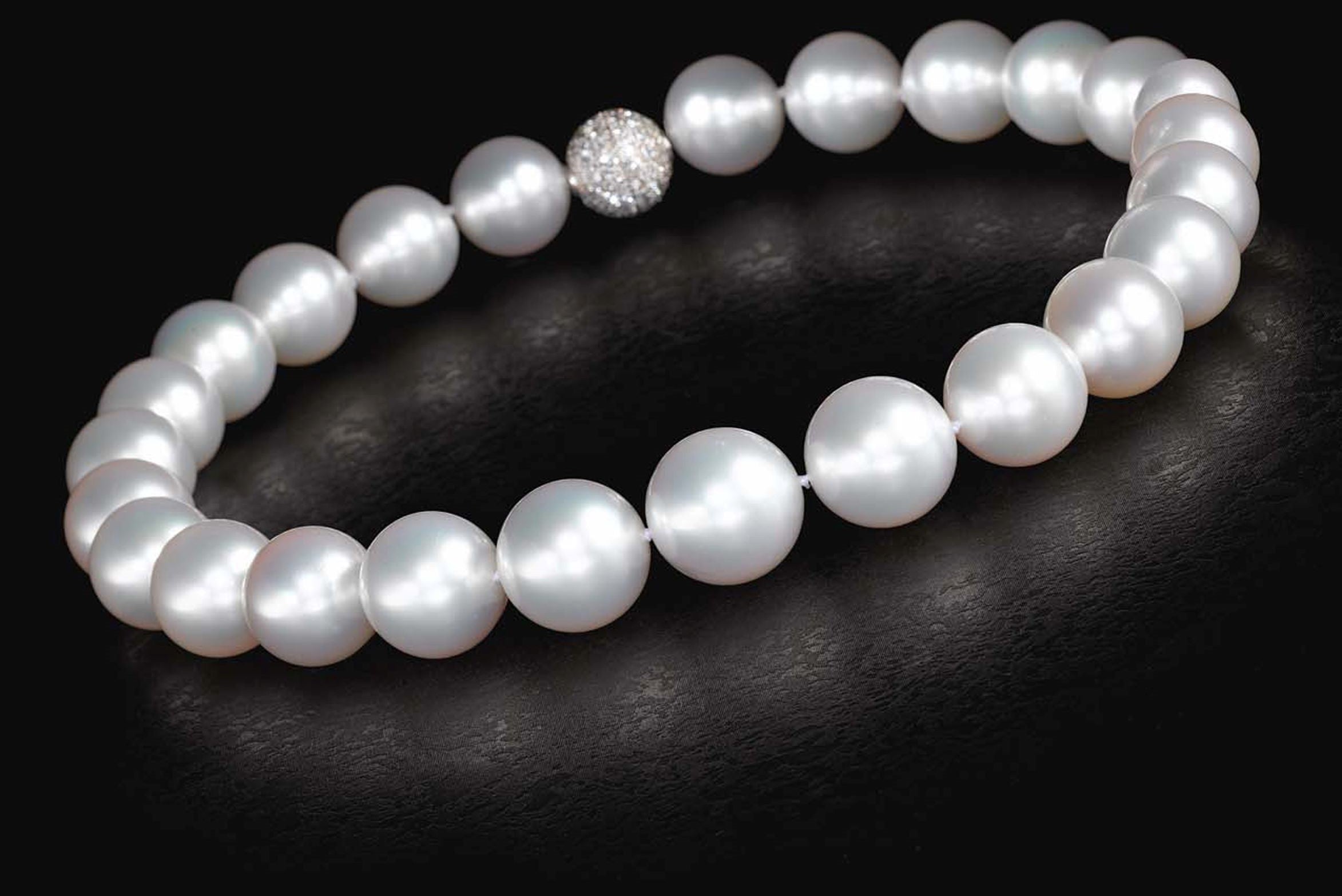
TARA White South Sea Pearl Necklace
16.0-13.3mm White South Sea pearl necklace, with an 18K diamond pave clasp, 3.00cttw of diamonds. This elegant necklace is 16.5″ long and has 29 pearls.
Product ID : 1A60248
Price: $81,663
TARA White South Sea Pearl Necklace 11.90-11.00mm White South Sea pearl...
VIEW DETAILS QUICK PREVIEW1K60573 – $30,093
TARA White South Sea Pearl Necklace
11.90-11.00mm White South Sea pearl necklace, with an 18K diamond pave clasp, 1.25cttw of diamonds. This elegant necklace is 18″ long and has 37 pearls.
Product ID : 1K60573
Price: $30,093
TARA Multicolor Pearl Necklace 16.35-13.0mm Multi Tahitian, Golden...
VIEW DETAILS QUICK PREVIEW1MT60003 – $52,526
TARA Multicolor Pearl Necklace
16.35-13.0mm Multi Tahitian, Golden South Sea, and White South Sea pearl necklace, with an 18K yellow gold diamond clasp, 0.45cttw of diamonds. This elegant necklace is 17.5″ long and has 29 pearls.
Product ID : 1MT60003
Price: $52,526
How Pearls are Formed: There are essentially three types of pearls:...
VIEW DETAILS QUICK PREVIEW2. How Pearls are Formed
How Pearls are Formed:
There are essentially three types of pearls: natural, cultured and imitation. A natural pearl (often called an Oriental pearl) forms when an irritant, such as a piece of sand, works its way into a particular species of oyster, mussel, or clam. As a defense mechanism, the mollusk secretes a fluid to coat the irritant. Layer upon layer of this coating is deposited on the irritant until a lustrous pearl is formed.

Oyster Shells being chosen for the cultivation process
A cultured pearl undergoes the same process. The only difference is that the irritant is a surgically implanted bead or piece of shell called Mother of Pearl. Often, these shells are ground oyster shells that are worth significant amounts of money in their own right as irritant-catalysts for quality pearls. The resulting core is, therefore, much larger than in a natural pearl. Yet, as long as there are enough layers of nacre (the secreted fluid covering the irritant) to result in a beautiful, gem-quality pearl, the size of the nucleus is of no consequence to beauty or durability.

Pearl Grafting being performed on a oyster
Pearls can come from either salt or freshwater sources. Typically, saltwater pearls tend to be higher quality, although there are several types of freshwater pearls that are considered high in quality as well. Freshwater pearls tend to be very irregular in shape, with a puffed rice appearance the most prevalent. Nevertheless, it is each individual pearls merits that determines value more than the source of the pearl.

Underwater view of a pearl farm
Regardless of the method used to acquire a pearl, the process usually takes several years. Mussels must reach a mature age, which can take up to 3 years, and then be implanted or naturally receive an irritant. Once the irritant is in place, it can take up to another 3 years for the pearl to reach its full size. Often, the irritant may be rejected, the pearl will be terrifically misshapen, or the oyster may simply die from disease or countless other complications. By the end of a 5 to 10 year cycle, only 50% of the oysters will have survived. And of the pearls produced, only approximately 5% are of substantial quality for top jewelry makers From the outset and from that small percentage, TARA pearls uses only an even smaller percentage.

Resulting Pearl after 4 to 6 years of growth
Where Pearls come from: Pearls predominately come from Japan,...
VIEW DETAILS QUICK PREVIEW3. Where Pearls come from
Where Pearls come from:
Pearls predominately come from Japan, Australia, Indonesia, Myanmar, China, India, Philippines, and Tahiti. The South Sea waters around Australia, Indonesia, and Myanmar are renowned for their large, white and gold pearls, while Japan’s pearls are highly valued for their lustrous character. Freshwater pearls constitute the bulk of China’s pearl efforts.

The picture shows locations where pearls are prevalent.
Akoya Pearls:
Akoya pearls are the classic cultured pearls of Japan. They are the most lustrous of all pearls found anywhere in the world. In recent years, China has been successful in producing Akoya Pearls within their own waters. However, at this time they are unable to produce as brilliant a luster as high quality Japanese Akoya cultured pearls.
White & Gold South Sea Pearls:
Regarded as the prize of pearls, White and Gold South Sea cultured pearls are grown in large tropical or semi-tropical oysters in Australia, Myanmar, Indonesia and other Pacific countries. They generally range in size from 10mm to 20mm and command premium prices because of their relative rarity and large size.
Tahitian Pearls:
Tahitian black cultured pearls are grown in a variety of large pearl oysters found primarily in French Polynesia. Their beautiful, unique color and large size can command very high prices. Tahitian pearls also naturally come in 26 different shades of colors from a peacock green to a blue, green, or black colors.

Map showing where pearls are grown
Silver Tahitian Pearl Necklace 10 x 12mm Multi-Color Tahitian pearl...
VIEW DETAILS QUICK PREVIEW3K41103C – $9,900
Silver Tahitian Pearl Necklace
10 x 12mm Multi-Color Tahitian pearl necklace with a 18k white gold clasp.
Product ID : 3K41103C
Price: $9,900
Newletter Subscription
SUBSCRIBE TO OUR NEWSLETTER & RECEIVE EXCLUSIVE UPDATES